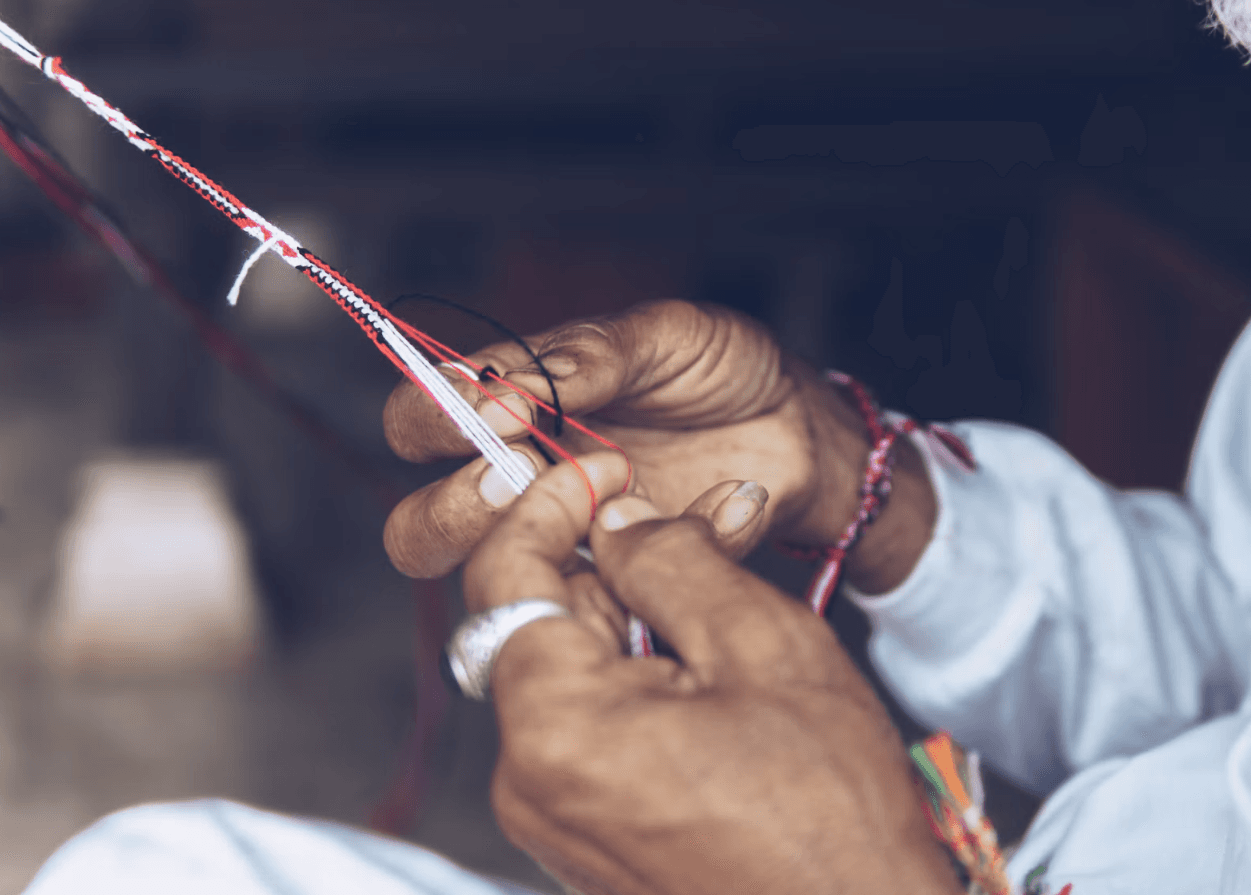
Why not braid by machine
A braiding machine can turn out several hundred cords an hour, every one identical in tension, knot spacing and length. Tidy — but you cannot tell who made it.
Hand braiding is different. From start to finish a cord is pulled and adjusted dozens of times, and each pull leaves a trace. Two cords of the same design, side by side, never share exactly the same texture.
Three places you can see it
The start: a hand-braided cord begins with a small tucked opening, the ends hidden inside — no plastic sleeve.
The knot: the two sides of the main knot usually differ slightly in tension, because of the angle of the wrist. A machine cannot do that.
The finish: the last section gets an extra turn or two, the cut end burned flat. It feels round, not flat.
On tension
No hand holds exactly the same tension for every loop. Some call that a flaw; it is the simplest way to tell. Fold the cord, let go, and it springs back into a shape with a slight bend of its own, never a perfect circle.
We do not file those traces away to look neater. Filed away, it would just be machine stock.
What we do before shipping
- Pull the whole cord once to confirm the main knot will not slip
- Wrap it on a wrist form to check the finish does not scratch
- Check the burned ends so it will not come apart later
- Photograph it and file the image with the order
Care: cord dislikes water and sweat
Natural fibre stiffens when wet, and repeated wet-dry cycles weaken it. Take it off for washing, showers and swimming; in sweaty months wipe it with a dry cloth every few days.
If it does get wet, dry it in the shade. No hairdryer, no direct sun — heat makes the fibre brittle.